EV Battery Diagnostics: How to Check Health, Fault Codes & What to Watch For
A comprehensive guide to EV battery diagnostics in the UK — from understanding State of Health (SoH) to reading P0A00-series fault codes, plus the tools and costs involved.
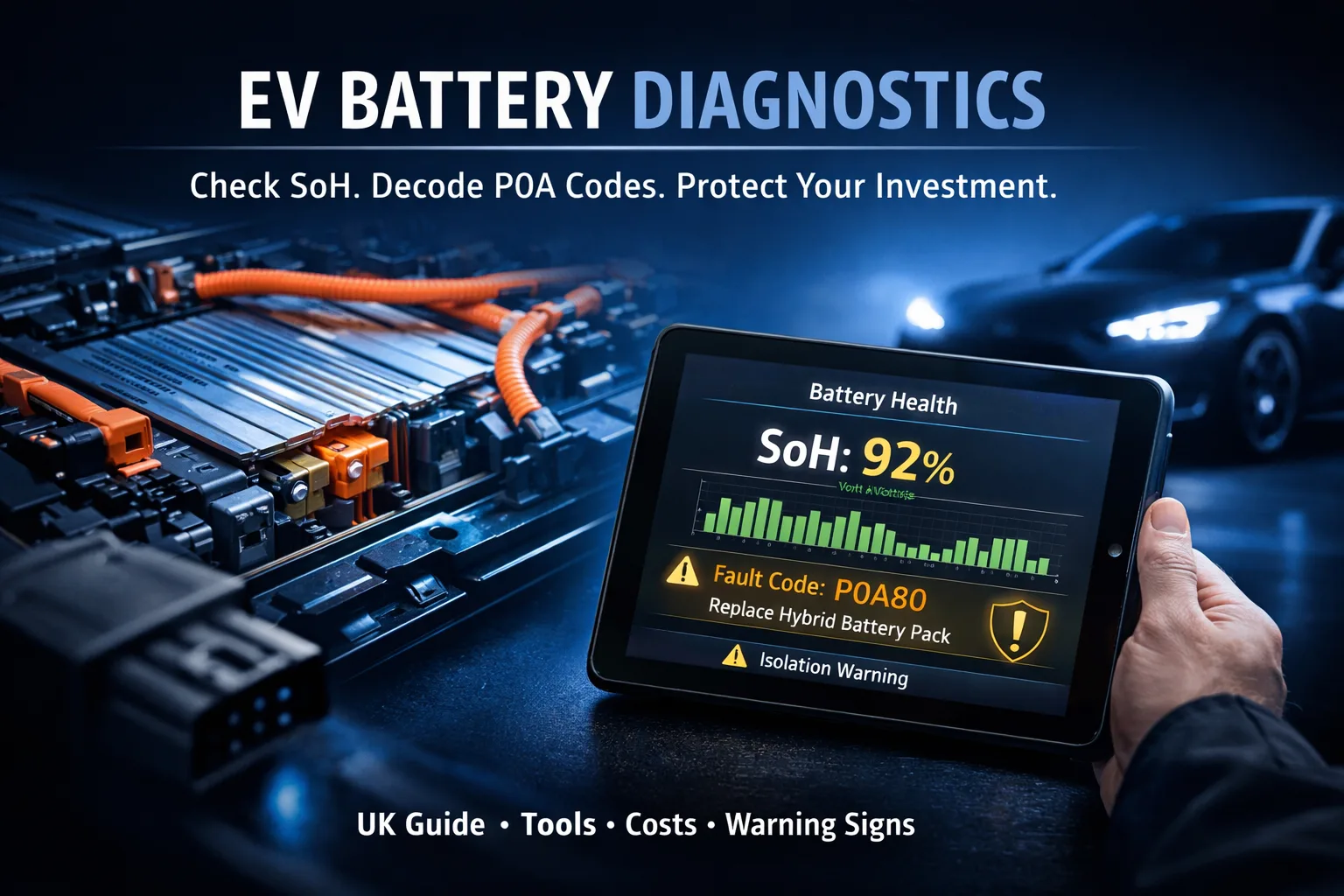
With over 1.1 million fully electric vehicles now registered on UK roads as of early 2026, understanding EV battery diagnostics is no longer a niche skill — it's essential knowledge for drivers and technicians alike. The high-voltage battery pack is the single most expensive component in any electric vehicle, typically representing 30–40% of the car's total value. Knowing how to check its health, interpret fault codes, and spot early warning signs can save you thousands of pounds and prevent unexpected breakdowns.
This guide covers everything you need to know about EV battery diagnostics in the UK, whether you're a current EV owner, considering buying a used electric car, or a technician expanding your skills.
What Is Battery State of Health (SoH)?
State of Health (SoH) is the single most important metric for any EV battery. Expressed as a percentage, SoH represents the current maximum capacity of your battery compared to when it was brand new. A battery with 90% SoH can hold 90% of its original charge — meaning if your car originally had a 40 kWh battery, it now effectively has 36 kWh of usable capacity.
SoH is not the same as State of Charge (SoC), which simply tells you how full your battery is right now (like a fuel gauge). SoH tells you about the long-term condition of the battery cells themselves.
How SoH Degrades Over Time
All lithium-ion batteries degrade over time. This is normal and unavoidable, but the rate of degradation varies significantly based on several factors:
- Calendar ageing — Batteries lose capacity simply by existing, even when not in use. Expect roughly 1–2% per year from calendar ageing alone.
- Cycle ageing — Every charge/discharge cycle causes a tiny amount of wear. Rapid DC charging accelerates this compared to slow AC charging.
- Temperature extremes — Both extreme heat and cold stress the battery. The UK's temperate climate is actually quite kind to EV batteries compared to hotter regions.
- Charging habits — Regularly charging to 100% or letting the battery drop below 10% increases wear. Most manufacturers recommend keeping the charge between 20% and 80% for daily use.
Most modern EV batteries are warrantied for 8 years or 100,000 miles to retain at least 70% SoH. Real-world data suggests that many batteries are comfortably exceeding this, with typical degradation of 2–3% per year in normal UK driving conditions.
Common EV Battery Fault Codes
EV battery systems use a specific range of OBD2 fault codes, primarily in the P0A00–P0AFF range. These are standardised codes defined by SAE J2012 specifically for hybrid and electric vehicle powertrains. Understanding them is critical for accurate diagnosis.
P0A00-Series Codes
| Code | Description | Severity | Typical Cause |
|---|---|---|---|
| P0A00 | Motor Electronics Coolant Temperature Sensor Circuit | Medium | Faulty coolant temp sensor or wiring issue in the power electronics cooling circuit |
| P0A80 | Replace Hybrid Battery Pack | Critical | Battery management system has determined the pack is below serviceable threshold — often triggered when SoH drops below manufacturer minimum |
| P0AA6 | Hybrid Battery Voltage System Isolation Fault | Critical | Loss of high-voltage isolation — potentially dangerous. Could indicate damaged insulation, moisture ingress, or a compromised battery casing |
| P0A1F | Hybrid Battery Negative Contactor Control Circuit | High | The main negative contactor (high-voltage relay) is not responding correctly. May indicate a stuck relay or control circuit fault |
| P0A09 | DC/DC Converter Status Circuit Low | High | The 12V DC/DC converter (which replaces the alternator in an EV) is reporting low output. Can cause auxiliary system failures |
| P0AFA | Hybrid Battery Pack Over-Temperature | Critical | Battery temperature has exceeded safe limits. Often caused by failed cooling pump, blocked coolant lines, or excessive rapid charging in hot conditions |
| P0A3F | Drive Motor A Position Sensor Circuit | Medium | Resolver or encoder fault in the electric motor — affects torque control and regenerative braking |
Important: Any code flagged as Critical should not be ignored. An isolation fault (P0AA6) in particular is a safety concern — the vehicle should not be driven until inspected by a qualified EV technician.
Manufacturer-Specific Codes
Beyond the standard P0A range, each manufacturer has proprietary codes. For example, Nissan Leaf uses codes in the P31xx range for battery cell monitoring, while Tesla uses its own internal diagnostic system accessible only through Tesla Service Mode or specialist third-party tools. BMW i-series vehicles use P0D prefix codes for their high-voltage battery system.
How to Check Your EV Battery Health
DIY Methods
Several approaches are available for checking your EV battery health without visiting a dealer:
- Built-in dashboard readout — Some EVs display SoH directly. The Nissan Leaf shows battery health bars on the dashboard (12 bars = 100%, each bar roughly represents 6.25% capacity). Tesla shows estimated range but does not display a direct SoH percentage without third-party tools.
- Manufacturer apps — The MyNissan, MyBMW, and similar apps often include battery condition data, though detail levels vary significantly.
- Third-party apps and dongles — This is the most popular DIY approach:
- LeafSpy Pro (Android/iOS, £5–10) with an OBD2 Bluetooth dongle — gives detailed cell voltages, SoH, temperature data, and charge cycles for Nissan Leaf.
- ABRP (A Better Routeplanner) — estimates battery degradation from trip data over time.
- Scan My Tesla (Android, £5) with OBD2 dongle — provides detailed Tesla battery data including cell voltage spread and energy throughput.
- Car Scanner ELM OBD2 — works with a wide range of EVs and can read battery-specific PIDs.
Professional Diagnostics
For a definitive assessment, professional EV battery diagnostics offer significantly more detail:
- Dealer diagnostic check — £80–£200. Uses manufacturer-specific tools (e.g., Nissan CONSULT III+, BMW ISTA) for a comprehensive battery report.
- Independent EV specialist — £60–£150. Companies like Cleevely EV, EV Clinic, and The EV Workshop offer battery health reports, often with quicker turnaround than main dealers.
- Battery certificate services — Companies like Aviloo (£100–£150) offer standardised battery health certificates that provide an independent, comparable SoH rating. These are increasingly popular for used EV sales.
Tools and Diagnostic Equipment
If you want to perform regular EV battery diagnostics, here is what you will need, ranging from budget to professional-grade:
OBD2 Scanners for EVs
- OBDLink LX Bluetooth (£25–35) — Budget dongle compatible with LeafSpy and other apps. Reliable for Nissan Leaf diagnostics.
- Vgate iCar Pro (£18–28) — Affordable BLE 4.0 dongle. Works with many EV diagnostic apps.
- OBDLink MX+ (£65–80) — Professional-grade wireless OBD2 adapter with faster data rates. Recommended for Tesla and other premium EVs.
- Autel MaxiSys MS906 Pro-TS (£1,500–£2,200) — Professional tablet scanner with comprehensive EV battery diagnostics, cell balancing data, and isolation testing for most manufacturers.
- Delphi DS150E (£800–£1,200) — Workshop-grade diagnostic tool with growing EV coverage.
Specialist Battery Analysers
- Megger MIT430/2 (£400–£600) — Insulation resistance tester for checking HV battery isolation. Essential for P0AA6 diagnosis.
- Fluke 1587 FC (£500–£700) — Combined insulation multimeter with Bluetooth data logging.
- GW Instek GBM-3300 (£2,000+) — Dedicated battery impedance meter for cell-level analysis. Used by battery refurbishment specialists.
When to Worry: Warning Signs
Not every sign of battery degradation means an expensive repair is imminent. Here is how to gauge the severity:
Normal Behaviour (No Action Needed)
- Range reduction of 1–3% per year in normal driving conditions
- Slightly lower range in winter (10–20% reduction is typical in UK winters)
- Occasional fluctuations in estimated range reading
- Marginally slower charging speeds at very high or very low SoC
Monitor Closely
- SoH dropping below 85% within the first 5 years
- Individual cell voltage differences exceeding 0.05V (check via diagnostic tool)
- Noticeable range reduction over a short period (more than 5% in a few months)
- Battery taking significantly longer to charge than it used to
Seek Professional Help Immediately
- Any high-voltage warning light on the dashboard
- Fault codes in the P0A80, P0AA6, or P0AFA range
- Burning or unusual chemical smell from beneath the vehicle
- Significant loss of power combined with warning lights
- Battery not accepting charge at all
- Visible damage, swelling, or leaking from the battery pack
UK Battery Replacement Costs
Battery replacement is the scenario every EV owner dreads, but costs have been falling steadily. Here are typical UK prices as of early 2026:
| Vehicle | Battery Size | Replacement Cost (inc. labour) | Notes |
|---|---|---|---|
| Nissan Leaf (24 kWh) | 24 kWh | £5,000–£7,000 | Refurbished packs available from £3,500 |
| Nissan Leaf (40 kWh) | 40 kWh | £7,000–£12,000 | Supply improving as more packs reach end-of-life |
| Tesla Model 3 SR+ | 60 kWh | £8,000–£12,000 | Tesla Service Centre only for warranty work |
| Tesla Model S/X | 75–100 kWh | £10,000–£15,000 | Older packs increasingly available refurbished |
| BMW i3 | 42 kWh | £8,000–£11,000 | Samsung SDI cells, modular replacement possible |
| Renault Zoe | 52 kWh | £7,000–£9,000 | Check if your Zoe has a battery lease — replacement may be covered |
| VW ID.3/ID.4 | 58–77 kWh | £9,000–£14,000 | Modular design allows individual module replacement |
| Hyundai Kona Electric | 64 kWh | £8,000–£12,000 | Many packs recalled/replaced under warranty (fire risk campaign) |
Tip: Before committing to a full battery replacement, ask about module-level replacement. If only one or two modules in the pack have failed, replacing just those modules can cut costs by 50–70%. An increasing number of independent EV specialists in the UK now offer this service.
Tips for Maintaining Battery Health
Prevention is far cheaper than replacement. Follow these evidence-based tips to maximise your EV battery lifespan:
- Keep daily charge between 20–80% — Only charge to 100% when you need the full range for a long journey. Most EVs let you set a charge limit in the car or app.
- Prefer slow charging — Use a 7 kW home wallbox for daily charging. Save rapid DC charging for long journeys. Data from fleet studies shows that EVs predominantly rapid-charged show 10–15% more degradation over 5 years compared to those mostly slow-charged.
- Avoid letting the battery sit at very high or very low charge — If storing the car for weeks, leave it at around 50% SoC.
- Park in shade during hot weather — Less of an issue in the UK than in southern Europe, but still good practice during summer heatwaves.
- Pre-condition the battery before rapid charging — Many modern EVs (Tesla, VW, BMW) will warm the battery en route to a rapid charger if you set it as your navigation destination. This dramatically improves charging speed and reduces stress on the cells.
- Keep software up to date — Manufacturers regularly push battery management optimisations via OTA updates.
- Drive smoothly — Aggressive acceleration and hard regenerative braking create heat. Smooth driving keeps battery temperatures lower.
- Service the cooling system — Liquid-cooled battery packs (used by Tesla, BMW, VW, Hyundai) rely on coolant. Have it checked at service intervals, typically every 4–6 years.
By following these guidelines, most EV owners in the UK can expect their battery to retain over 80% SoH after 10 years and 150,000+ miles — well beyond the point where they would typically change vehicles.
If you are concerned about your EV battery health, try running your vehicle details through AI Mechanic for a free initial assessment. Our diagnostic engine can help you understand fault codes, estimate battery condition based on your vehicle's age and mileage, and recommend next steps.
Written by
AI Mechanic Team
25+ years of real-world automotive diagnostic experience. Covering fault code analysis, MOT preparation, vehicle checks, and modern vehicle technology across the UK.