Should I Buy a Used Nissan Qashqai? Diagnostic Red Flags & Common Problems
The Nissan Qashqai is the UK's best-selling crossover, but which generation should you buy? We cover common faults, diagnostic red flags, and repair costs by model year.
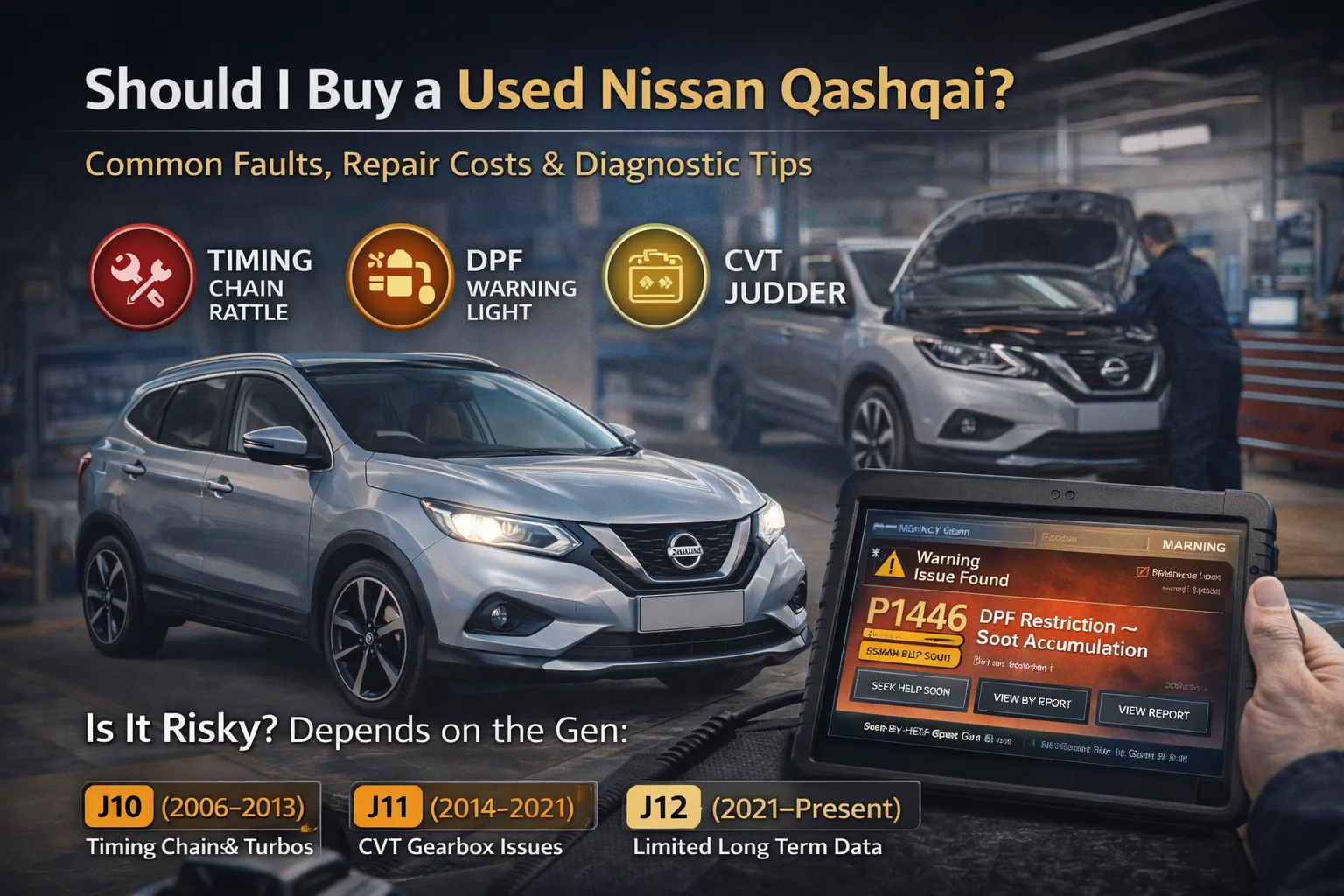
The Nissan Qashqai has been the UK's best-selling crossover since it first arrived in 2006, and for good reason. It practically invented the segment, offering SUV styling and a raised driving position in a package that drives like a hatchback and fits in a supermarket parking space. Over 1.5 million have been sold in the UK alone.
But popularity does not mean perfection. Each generation of Qashqai has its known weak points, and buying the wrong one without a proper check can lead to expensive repair bills. This guide covers every generation's common problems, the diagnostic red flags to look for during a test drive, and what a pre-purchase OBD2 scan should reveal.
Qashqai Overview: Three Generations
The Qashqai has gone through three distinct generations, each with significantly different engines, transmissions, and technology:
| Generation | Years | Code | Key Engines | Used Price Range |
|---|---|---|---|---|
| First (J10) | 2006–2013 | J10 | 1.5 dCi, 1.6 dCi, 1.6 petrol, 2.0 petrol, 2.0 dCi | £2,000–£6,000 |
| Second (J11) | 2014–2021 | J11 | 1.2 DIG-T, 1.5 dCi, 1.6 dCi, 1.3 DIG-T (from 2019) | £7,000–£18,000 |
| Third (J12) | 2021–present | J12 | 1.3 DIG-T mild hybrid, e-POWER (series hybrid) | £18,000–£32,000 |
J10 (2006–2013): Common Problems
The original Qashqai is now 13–20 years old. At this age, condition matters far more than mileage. A well-maintained 120,000-mile example can be better than a neglected 60,000-mile one. Here are the key issues to watch for:
Timing Chain Stretch (1.6 Petrol HR16DE)
The 1.6 petrol engine uses a timing chain rather than a belt. While chains are designed to last the life of the engine, the early HR16DE units suffered from chain stretch, particularly on higher-mileage examples. Symptoms include a rattling noise on cold start that disappears after 10–30 seconds, rough idle, and eventually a P0011 or P0014 (camshaft timing over-advanced) fault code.
Repair cost: £800–£1,500 including chain, tensioner, guides, and labour. This is the single most expensive potential repair on a J10 Qashqai.
DPF Problems (1.5 dCi and 2.0 dCi)
The diesel engines fitted with a DPF (Diesel Particulate Filter) suffer when used predominantly for short urban journeys. The DPF needs regular motorway-speed driving to regenerate (burn off accumulated soot). Symptoms: DPF warning light, loss of power, limp mode, and fault codes P2002 (DPF efficiency below threshold) or P2463 (DPF soot accumulation).
Repair cost: Forced regeneration £100–£200, chemical clean £300–£500, replacement £800–£1,500.
Turbo Failure (1.5 dCi)
The Renault-sourced K9K 1.5 dCi engine is generally reliable, but turbos can fail from 80,000 miles onwards, particularly if oil changes have been neglected. Listen for a whining noise from the turbo area that increases with engine speed, and check for oil in the intercooler pipework.
Repair cost: £600–£1,200 for a refurbished turbo fitted.
Power Steering Issues
The J10 uses an electric power steering column that can develop faults. Symptoms include intermittent loss of power assistance, a steering warning light, and fault code C1612. Some were subject to a Nissan recall.
Repair cost: £300–£800 for a refurbished steering column. Always check if the recall work was completed on the car you are viewing.
Other J10 Issues to Check
- Rear subframe corrosion — check for rust around the rear subframe mounts, particularly on early models and those from coastal areas.
- Window regulators — electric window mechanisms fail, particularly on the driver's door (£80–£150 to replace).
- Clutch dual-mass flywheel — diesels can need DMF replacement from 70,000 miles. Listen for a rattling at idle in neutral (£500–£900 for DMF and clutch).
J11 (2014–2021): Common Problems
The second-generation Qashqai was a significant step forward in quality, but introduced its own set of issues. This is currently the sweet spot for used buyers, with prices ranging from £7,000 to £18,000 depending on age, mileage, and specification.
CVT Gearbox Issues (Xtronic)
This is the big one. The Xtronic CVT (Continuously Variable Transmission) automatic gearbox, offered as an option on many J11 models, has a mixed reliability record. Problems include juddering at low speeds, hesitation when pulling away, overheating under heavy load (especially towing), and premature wear. Fault codes P0868 (transmission fluid pressure low) and P0746 (pressure control solenoid performance) are common indicators.
Repair cost: CVT fluid change £200–£350, valve body repair £800–£1,500, complete CVT replacement £3,000–£5,000.
Our advice: If buying a J11 automatic, insist on a thorough test drive in urban traffic, including hill starts and slow-speed manoeuvring. Any juddering or hesitation is a red flag. The manual gearbox models do not suffer this issue and are generally the better buy.
Fuel Injector Problems (1.5 dCi)
The 1.5 dCi diesel can suffer from injector seal leaks (known as the "black death" issue, where carbon deposits form around leaking injector seals) and injector failure. Symptoms include rough running, excessive smoke, diesel smell in the cabin, and fault codes P0201–P0204 (injector circuit malfunction).
Repair cost: Injector seal replacement £150–£300, injector replacement £200–£400 each.
Stop-Start System Failures
The stop-start system can become unreliable as the battery ages. The system requires a specific AGM (Absorbent Glass Mat) battery, and fitting a standard battery will cause malfunctions. Symptoms: stop-start stops working, battery warning messages, difficulty starting.
Repair cost: AGM battery replacement £120–£200. Always replace with the correct AGM specification.
DPF Issues (1.5 dCi and 1.6 dCi)
The same DPF issues as the J10 apply to the J11 diesels, compounded by the fact that many Qashqais are used as urban family cars — exactly the driving pattern that prevents DPF regeneration. The J11's DPF system is more sophisticated but still needs regular motorway runs.
Repair cost: Same as J10 — forced regen £100–£200, chemical clean £300–£500, replacement £800–£1,500.
Other J11 Issues to Check
- Panoramic sunroof rattles — the optional panoramic sunroof can develop rattles and, in rare cases, water leaks (£100–£400 to address).
- Sat-nav/infotainment freezing — the NissanConnect system can freeze or become unresponsive. Software updates are available from Nissan dealers.
- Clutch and DMF — manual diesel models may need clutch and dual-mass flywheel replacement from 60,000–80,000 miles (£500–£900).
- Rear brake binding — rear brake calipers can seize, causing uneven pad wear and reduced fuel economy (£100–£200 per side for caliper refurbishment or replacement).
J12 (2021–Present): Common Problems
The current Qashqai is still relatively new, so the long-term reliability picture is not yet complete. However, some early trends are emerging:
Mild Hybrid System (1.3 DIG-T MHEV)
The 1.3-litre turbocharged petrol engine with 12V mild hybrid system is the most common powertrain. Early reports suggest the mild hybrid system itself is reliable, but the 1.3 DIG-T engine (co-developed with Mercedes-Benz) has had reports of excessive oil consumption in some units. Check the oil level during your inspection and look for blue smoke on start-up.
Repair cost: If covered under warranty, nil. Otherwise, investigation £100–£200, potential piston ring replacement £1,500–£3,000.
Infotainment and Software
The J12's heavily digital cockpit relies on a 12.3-inch digital instrument cluster and a 9-inch central screen. Software bugs have been reported, including screen blackouts, connectivity issues with Apple CarPlay/Android Auto, and around-view camera glitches. Nissan has issued multiple software updates.
Repair cost: Software updates are free at Nissan dealers. Hardware faults are covered under warranty.
e-POWER Drivetrain
The e-POWER variant uses a 1.5-litre petrol engine purely as a generator to power an electric motor that drives the wheels. It is essentially a series hybrid — you always drive on electric power. Early reliability data is limited, but the powertrain is shared with the Nissan Note e-POWER that has been sold in Japan since 2016 with a solid track record. The main thing to watch is the small 2.1 kWh battery pack — it cycles much more frequently than a traditional hybrid battery.
Repair cost: Too early for aftermarket data. Covered by Nissan's 5-year/60,000-mile warranty.
Other J12 Issues to Check
- Windscreen reflections — Some owners report distracting dashboard reflections in the windscreen, particularly with lighter interior trims. Not a mechanical issue but worth checking on a sunny test drive.
- ProPILOT calibration — The ProPILOT driver assistance system occasionally needs camera recalibration after a windscreen replacement (£100–£200).
- Suspension noise — Some early J12s had reports of rear suspension clunking over rough surfaces. Nissan issued a technical service bulletin addressing anti-roll bar end link torque specification.
Diagnostic Red Flags When Test Driving
When viewing any used Qashqai, use this targeted checklist during the test drive:
- Cold start the engine yourself. Listen for timing chain rattle (J10 petrol), turbo whine (diesels), or rough running (injector issues). The seller should not have warmed the car up before you arrive.
- Check the dashboard. With ignition on but engine off, all warning lights should illuminate. When the engine starts, they should all go out within a few seconds. Any light remaining on (especially engine management, DPF, airbag, or ABS) is a fault.
- Drive in slow traffic. If it is an automatic (CVT), pay close attention to any juddering, hesitation, or jerking at low speeds. Drive uphill from a standstill — the CVT should pull smoothly without shuddering.
- Reach motorway speed. Listen for wheel bearing noise (humming that changes with speed but not steering input), gearbox whine, and check that all gears engage smoothly on manual models.
- Test the brakes. Brake firmly from 40 mph. The car should stop in a straight line without pulling to one side. Any vibration through the steering wheel indicates warped discs.
- Full-lock turns. In a car park, turn the steering to full lock in both directions. Listen for clicking (worn CV joints) or groaning (power steering issues).
- Check the exhaust. On diesel models, watch for excessive black smoke on acceleration (DPF issue or worn turbo) or white/blue smoke (head gasket or worn valve seals).
- Test all electronics. Windows, mirrors, air conditioning (including heating), all lights, sunroof if fitted, and sat-nav/infotainment.
Pre-Purchase Diagnostic Check: What to Look for with an OBD Scanner
A £20–50 OBD2 scanner can reveal hidden problems that are not visible during a test drive. Before buying any used Qashqai, plug in a scanner and check:
- Stored fault codes — Even if no warning lights are showing, there may be stored or pending codes. A recently cleared code history (all monitors showing "not ready") is a red flag — it suggests the seller cleared codes before the viewing.
- Monitor readiness — All emissions monitors should show "ready" or "complete". If several show "not ready", codes were likely cleared recently. It takes 50–100 miles of varied driving for all monitors to reset.
- Live data: coolant temperature — Should reach 80–95°C during the test drive. If it stays low, the thermostat may be stuck open (P0128). If it climbs above 100°C, there may be a cooling system issue.
- Live data: fuel trims — Long-term fuel trim (LTFT) should be within ±10%. Values beyond this indicate a fuelling problem (lean = possible vacuum leak or weak fuel pump; rich = possible faulty injector or sensor).
- CVT temperature (automatics) — If using a Nissan-compatible scanner, check CVT fluid temperature. It should stabilise below 100°C during normal driving. Persistently high temperatures indicate a stressed or worn CVT.
- DPF soot level (diesels) — If the scanner can read DPF data, check the soot loading percentage. Below 50% is healthy. Above 70% suggests the DPF is struggling to regenerate and may fail soon.
Expected UK Repair Costs
| Repair | Typical Cost (inc. parts and labour) | Applicable Generations |
|---|---|---|
| Timing chain replacement | £800–£1,500 | J10 (1.6 petrol) |
| CVT gearbox replacement | £3,000–£5,000 | J11 (automatic) |
| DPF clean (chemical) | £300–£500 | J10, J11 (diesel) |
| DPF replacement | £800–£1,500 | J10, J11 (diesel) |
| Turbo replacement (refurb) | £600–£1,200 | J10, J11 (diesel) |
| Clutch and DMF | £500–£900 | J10, J11 (manual diesel) |
| Fuel injector (each) | £200–£400 | J11 (1.5 dCi) |
| Power steering column (refurb) | £300–£800 | J10 |
| Rear brake caliper (per side) | £100–£200 | J11 |
| AGM battery | £120–£200 | J11, J12 |
| Annual service (independent) | £150–£250 | All |
| Annual service (Nissan dealer) | £200–£350 | All |
Our Recommendation
The Nissan Qashqai is a solid used buy if you know what to look for. Here is our generation-by-generation verdict:
Best Budget Buy: J10 1.5 dCi (2010–2013)
The facelifted J10 with the 1.5 dCi diesel is the sweet spot for budget buyers. It is the most reliable engine in the J10 range, returns 55–65 mpg in real-world driving, and can be found for £3,000–£5,000 in good condition. Avoid the 1.6 petrol unless you can verify the timing chain has been replaced. Make sure it does regular motorway runs if diesel.
Best Overall Buy: J11 1.2 DIG-T or 1.3 DIG-T Manual (2017–2021)
The petrol manual J11 avoids the CVT gearbox concerns and the DPF issues of the diesels. The 1.2 DIG-T (115 PS) is perfectly adequate for most driving, while the 1.3 DIG-T (140 or 160 PS) from 2019 onwards is noticeably more refined. Expect to pay £9,000–£16,000 for a well-specified example.
Best Nearly-New: J12 1.3 DIG-T Mild Hybrid
If your budget stretches to a J12, the mild hybrid petrol is the sensible choice. Build quality is a significant step up from the J11, the technology is excellent, and early reliability is promising. The e-POWER is intriguing but we would wait for more long-term data before recommending it unreservedly.
Whatever generation you are considering, always get an independent pre-purchase inspection and run a diagnostic scan before handing over your money. A £100–£150 inspection fee is trivial compared to a £3,000 CVT replacement or a £1,500 timing chain job. And if you want to decode any fault codes that come up during your check, AI Mechanic can help you understand exactly what they mean and what they will cost to fix.
Written by
AI Mechanic Team
25+ years of real-world automotive diagnostic experience. Covering fault code analysis, MOT preparation, vehicle checks, and modern vehicle technology across the UK.