UK MOT Failures 2026: Top Causes, Prevention Checklist & What Examiners Really Look For
Based on the latest DVSA data, we break down the most common MOT failure reasons in the UK for 2026, with a practical prevention checklist.
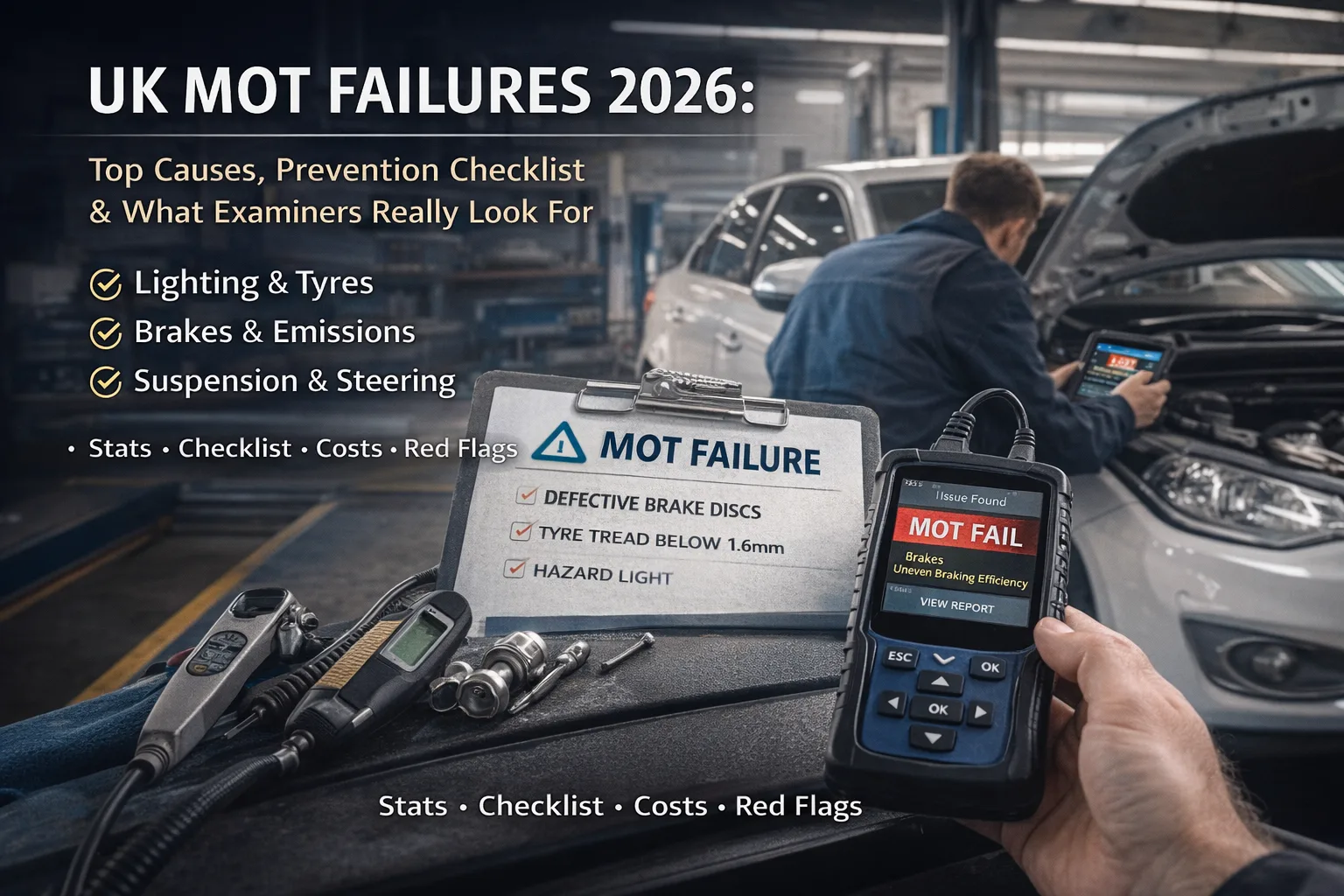
Roughly one in three cars fails its MOT on the first attempt in the UK. That is over 10 million failure items issued every year across approximately 32 million tests. The frustrating part? The vast majority of these failures are caused by minor, inexpensive issues that could have been spotted and fixed beforehand.
This guide breaks down the latest DVSA (Driver and Vehicle Standards Agency) data on MOT failure reasons, gives you a practical 20-point checklist to run through before your test, and explains exactly what examiners are looking for in each area. Whether your car is due for its first MOT at three years old or it is a veteran of the annual test, this information will help you pass first time.
MOT Failure Statistics: Where Cars Really Fall Down
According to the latest DVSA data compiled from millions of MOT tests, the top reasons for failure break down as follows:
| Rank | Failure Category | % of All Failures | Typical Fix Cost |
|---|---|---|---|
| 1 | Lighting and signalling | 12.75% | £5–£50 |
| 2 | Suspension | 10.67% | £150–£600 |
| 3 | Brakes | 9.20% | £80–£400 |
| 4 | Tyres | 8.50% | £50–£150 per tyre |
| 5 | Driver's view of the road (visibility) | 6.80% | £10–£350 |
| 6 | Fuel and exhaust (emissions) | 6.30% | £50–£500+ |
| 7 | Steering | 5.40% | £100–£500 |
| 8 | Body, structure and general items | 4.90% | £50–£800+ |
| 9 | Wheels and axles | 3.80% | £40–£200 |
| 10 | Seatbelts and supplementary restraints | 2.60% | £20–£250 |
The striking thing about this data is that the number one failure reason — lighting — is almost always the cheapest to fix. A blown headlight bulb costs £5–15 and takes minutes to replace, yet it accounts for nearly 13% of all failures.
Top 10 Failure Reasons: What Goes Wrong and How to Prevent It
1. Lighting and Signalling (12.75%)
By far the most common MOT failure. This category includes headlights, tail lights, brake lights, indicators, number plate lights, fog lights, and hazard warning lights.
Common issues: Blown bulbs, cracked or misted lenses, incorrect headlight alignment, aftermarket LED bulbs that are not E-marked, dim or flickering connections.
Prevention: Walk around your car with the lights on the evening before your MOT. Have someone press the brake pedal while you check the rear. Replace any blown bulbs and clean dirty lenses. Cost: £5–£15 per bulb for most cars.
2. Suspension (10.67%)
Suspension components wear gradually, making them easy to overlook until they fail an MOT inspection.
Common issues: Worn shock absorbers (dampers), broken coil springs, perished anti-roll bar bushes, worn ball joints, failed drop links.
Prevention: Listen for knocking or clunking sounds over bumps. Check for uneven tyre wear (a sign of worn suspension). Push down firmly on each corner of the car — it should bounce back once and settle. More than one bounce suggests worn dampers. Cost: Shock absorbers £150–£300 per pair fitted, drop links £60–£120 per pair, coil spring £80–£200 each.
3. Brakes (9.20%)
Brake failures include worn pads, warped or worn discs, seized calipers, corroded brake lines, and faulty handbrake mechanisms.
Common issues: Brake pads below minimum thickness (1.5mm), disc scoring or lip formation, binding calipers causing uneven wear, handbrake not holding on the gradient test.
Prevention: Listen for squealing or grinding when braking. Check if the car pulls to one side under braking. If you can see through the wheel spokes, visually inspect the pad thickness. Test the handbrake on a hill — it should hold the car firmly within 3–4 clicks. Cost: Front brake pads £80–£180 fitted, front discs and pads £150–£350 fitted.
4. Tyres (8.50%)
The legal minimum tread depth in the UK is 1.6mm across the central three-quarters of the tread, around the entire circumference. However, many safety experts recommend replacing at 3mm.
Common issues: Tread below 1.6mm, cuts or bulges in the sidewall, uneven wear patterns, mismatched tyre types on the same axle, exposed cords.
Prevention: Use a 20p coin — insert it into the main tread grooves. If you can see the outer band of the coin, your tread is below 1.6mm and the tyre must be replaced. Check all four tyres plus any visible sidewall damage. Cost: £50–£150 per tyre depending on size and brand.
5. Driver's View of the Road (6.80%)
This covers windscreen damage, wiper condition, washers, and mirror condition.
Common issues: Windscreen chips or cracks in the swept area (larger than 10mm in the driver's direct view, or larger than 40mm elsewhere in the swept area), worn wiper blades leaving smears, empty washer reservoir, damaged or missing mirrors.
Prevention: Check your windscreen for chips, especially in front of the driver. Replace worn wiper blades (£10–£25). Top up washer fluid. Ensure all mirrors are present, secure, and not cracked. Cost: Wiper blades £10–£25, windscreen repair £50–£80, windscreen replacement £200–£350.
6. Fuel and Exhaust / Emissions (6.30%)
Diesel vehicles are particularly prone to emissions failures. Since 2018, any diesel with a DPF (Diesel Particulate Filter) fitted as standard will fail if the DPF has been removed or tampered with.
Common issues: High emissions readings, blocked or removed DPF, exhaust leaks, catalytic converter failure, EGR valve faults.
Prevention: Take your car for a 20–30 minute motorway run before the MOT to clear out the exhaust system and regenerate the DPF. Ensure no warning lights related to emissions are showing. Cost: DPF clean £200–£500, catalytic converter replacement £300–£1,000+, exhaust repair £50–£200.
7. Steering (5.40%)
Common issues: Worn track rod ends, damaged steering rack gaiters, excessive free play in the steering wheel, power steering fluid leaks.
Prevention: With the car stationary, turn the steering wheel left and right — there should be minimal free play before the wheels start to turn. Listen for clicking or knocking at full lock. Check for fluid leaks beneath the car at the front. Cost: Track rod end £60–£120 each fitted (plus alignment), steering rack gaiter £80–£150.
8. Body, Structure and General Items (4.90%)
Common issues: Excessive corrosion (rust) to structural areas, sharp edges from bodywork damage, insecure body panels, missing or illegible number plates, damaged seats or seat runners.
Prevention: Check the sills, floor pans, and chassis rails for rust. Look underneath the car for structural corrosion. Ensure number plates are clean, legible, and securely fixed. Cost varies hugely: a welded sill repair £200–£800, number plate replacement £15–£30.
9. Wheels and Axles (3.80%)
Common issues: Worn wheel bearings, cracked or buckled alloy wheels, loose wheel nuts, worn CV joints or boots.
Prevention: Listen for humming or droning that changes with speed (wheel bearing). Check for torn CV boots (the rubber gaiter on the driveshaft near each front wheel). Cost: Wheel bearing £100–£200 per side, CV boot £80–£150.
10. Seatbelts and Supplementary Restraints (2.60%)
Common issues: Seatbelts that do not retract properly, frayed or cut webbing, faulty buckles, airbag warning light illuminated on the dashboard.
Prevention: Pull each seatbelt out fully and check for fraying, cuts, or stiffness. Let it retract — it should do so smoothly. Check that the airbag warning light goes out after starting the engine (it is normal for it to illuminate briefly). If the airbag light stays on, this is an MOT failure. Cost: Seatbelt retractor £100–£250, airbag fault diagnosis £50–£100.
What Examiners Actually Check: The 5 Key Areas
MOT examiners follow the DVSA's official inspection manual, which breaks the test into five broad areas:
- Roadside inspection items — Lights, tyres, mirrors, windscreen, wipers, horn, number plates, exhaust, VIN/chassis number visibility.
- Under-bonnet checks — Brake fluid level, power steering fluid, battery security, structural condition of the engine bay, wiring condition, fuel system integrity.
- Interior checks — Seatbelts, seats, dashboard warning lights (airbag, ABS, power steering), speedometer, steering wheel condition, door latches.
- Under-vehicle inspection — Exhaust condition, brake pipes and hoses, fuel lines, suspension components, structural integrity (rust), driveshaft CV joints and boots.
- Brake performance test — Using a roller brake tester, the examiner checks that each wheel's braking force meets the minimum standard and that there is no excessive imbalance between left and right sides. The handbrake is tested separately.
Pre-MOT Checklist: 20 Items You Can Check at Home
Run through this checklist a few days before your MOT. Most items take seconds to check, and fixing them in advance could save you a retest fee and the hassle of a return visit.
- All headlights working (main beam and dipped)
- Both front and rear indicators working, flashing at correct rate
- Brake lights working (both sides plus high-level if fitted)
- Rear fog light(s) working
- Reversing light(s) working
- Number plate lights working and plates legible
- Windscreen free of cracks in the critical zone
- Wiper blades clearing the screen without smearing
- Washer fluid topped up and jets spraying windscreen
- Horn working
- All mirrors present, secure, and not cracked
- Tyre tread depth above 1.6mm on all four tyres
- No cuts, bulges, or damage to tyre sidewalls
- All seatbelts retracting, latching, and releasing properly
- Handbrake holding the car on a slope
- No dashboard warning lights staying on (especially airbag, ABS, power steering)
- Exhaust not blowing, no excessive noise
- Doors opening and closing properly from inside and outside
- Boot/tailgate opening from outside
- Fuel cap present and sealing
Advisories vs Failures: Understanding the Difference
Not every issue found during an MOT results in a failure. Since May 2018, MOT defects have been categorised into three levels:
- Dangerous — A direct and immediate risk to road safety. The car must not be driven until repaired. Examples: brake fluid leak, structural failure, bald tyre with cord showing.
- Major — A defect that affects safety, the environment, or does not meet legal requirements. This is an MOT failure and must be repaired before a pass certificate is issued. Examples: headlight not working, brake pad below minimum, excessive emissions.
- Minor / Advisory — A defect that does not cause an MOT failure but should be monitored or repaired soon. Examples: a tyre approaching the legal limit, a slightly misted headlight lens, light surface corrosion. These are recorded on the certificate and are valuable for planning future maintenance.
Tip: Always ask for the full list of advisories from your previous MOT. These are available free on the DVSA MOT history checker. Advisories from last year's test often become this year's failures.
Cost of Common MOT Repairs
Here is a realistic breakdown of what common MOT repairs cost at a typical independent garage in the UK in 2026:
| Repair | Typical Cost (inc. labour) | Time Required |
|---|---|---|
| Headlight/tail light bulb | £5–£15 | 10–20 minutes |
| Wiper blades (pair) | £10–£25 | 5 minutes |
| Number plate | £15–£30 | 5 minutes |
| Front brake pads | £80–£180 | 45–60 minutes |
| Front discs and pads | £150–£350 | 1–1.5 hours |
| Single tyre (fitted and balanced) | £50–£150 | 20–30 minutes |
| Shock absorbers (pair, fitted) | £150–£300 | 1.5–2 hours |
| Track rod end (each, inc. alignment) | £60–£120 | 45 minutes |
| Exhaust section repair/replacement | £50–£200 | 30–60 minutes |
| Catalytic converter | £300–£1,000+ | 1–2 hours |
| Windscreen chip repair | £50–£80 | 30 minutes |
| Windscreen replacement | £200–£350 | 1–2 hours |
| CV boot replacement | £80–£150 | 1 hour |
| Wheel bearing | £100–£200 | 1–1.5 hours |
| Seatbelt retractor | £100–£250 | 30–60 minutes |
| Coil spring | £80–£200 | 1–1.5 hours |
Seasonal Tips: Timing Your MOT Right
The UK MOT system creates predictable seasonal patterns that can affect your experience:
- February/March rush — The annual plate change in March means a huge volume of three-year-old cars enter the MOT system for the first time in February and March. Garages are extremely busy during this period. If your MOT is due around this time, book well in advance or take advantage of the fact that you can have your MOT done up to one month early without losing your existing renewal date.
- September/October — The second plate change creates another busy period for the same reason.
- Winter considerations — Cars tested in winter may be more likely to fail on lights (shorter days mean bulb failures are more noticeable) and corrosion (salt on roads accelerates rust). On the positive side, engines tend to run richer in cold weather, which can sometimes result in marginal emissions passes.
- Summer advantage — Drier conditions mean less corrosion exposure. Garages are typically less busy in June–August. If you have flexibility on timing, summer is often the easiest time to get your MOT done.
Remember: preparation is everything. A 15-minute walk-around check the week before your MOT, combined with addressing any advisories from last year, dramatically increases your chances of a first-time pass. Use AI Mechanic to look up any dashboard warning lights or fault codes before your test — it is free and could save you the cost of a retest.
Written by
AI Mechanic Team
25+ years of real-world automotive diagnostic experience. Covering fault code analysis, MOT preparation, vehicle checks, and modern vehicle technology across the UK.