Complete OBD2 Fault Code Guide: What Every Code Means & When to Worry
Your definitive guide to OBD2 fault codes — what the P, B, C, U prefixes mean, the top 20 most common codes, severity levels, and typical UK repair costs.
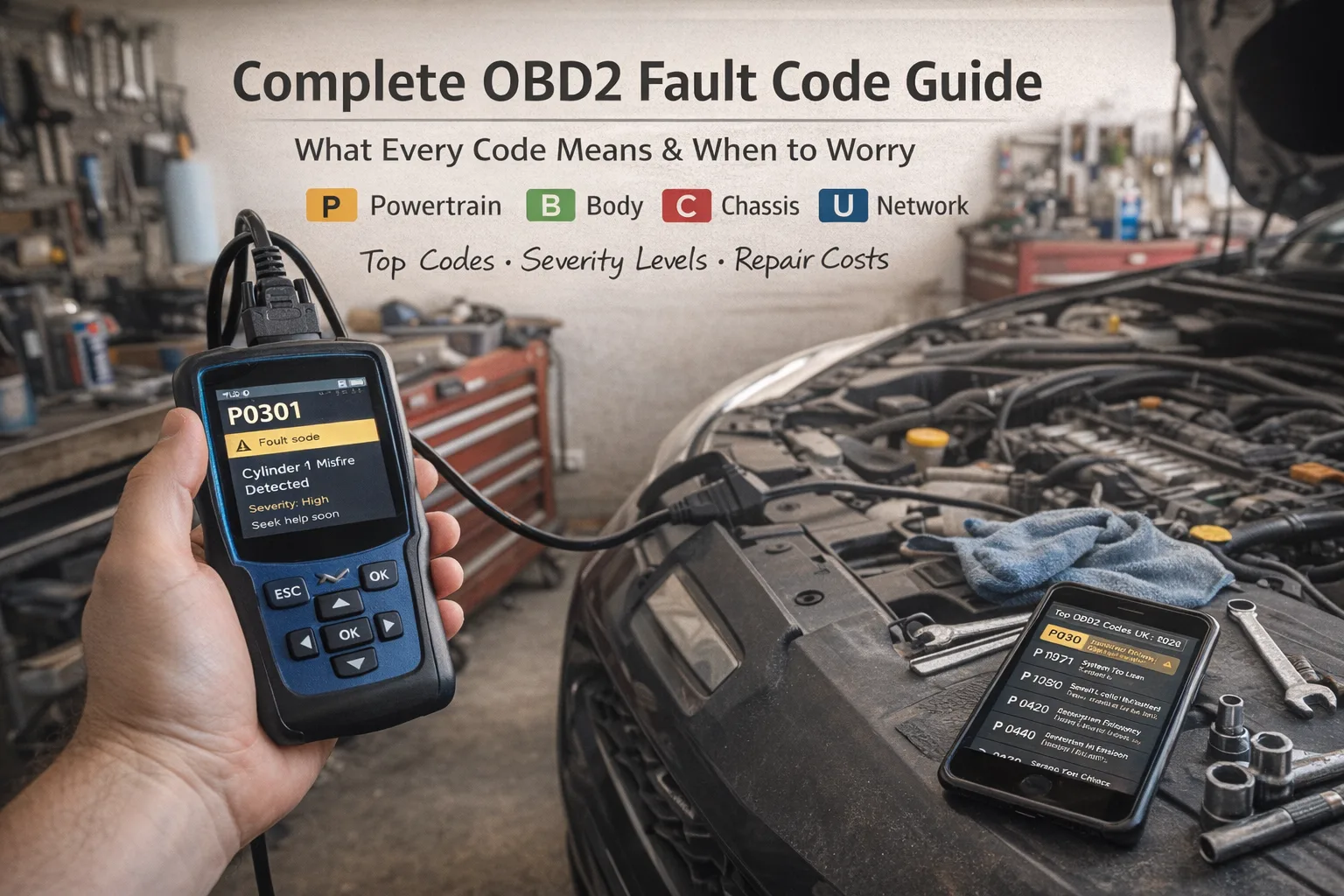
That amber check engine light has just come on. Your stomach drops. Is it serious? Is it safe to keep driving? Will it cost a fortune to fix? These are the questions every driver asks, and the answer lies in the OBD2 fault code stored in your car's computer.
OBD2 (On-Board Diagnostics, version 2) has been mandatory on all petrol cars sold in the UK since 2001 and all diesel cars since 2004. The system monitors dozens of sensors across your engine, transmission, emissions, and ancillary systems. When something falls outside expected parameters, it logs a standardised fault code and often illuminates the check engine light (MIL — Malfunction Indicator Lamp).
This guide explains the code structure, lists the 20 most common codes you are likely to encounter, and gives you the information you need to decide whether to keep driving, book a garage appointment, or pull over immediately.
Understanding the Code Structure
Every OBD2 fault code follows the same five-character format. Understanding this structure helps you quickly assess what system is affected.
First Character: The System
- P — Powertrain (engine, transmission, fuel system, ignition). By far the most common type.
- B — Body (airbags, seatbelts, climate control, interior electronics).
- C — Chassis (ABS, traction control, steering, suspension electronics).
- U — Network/Communication (CAN bus faults, module communication errors).
Second Character: Generic vs Manufacturer-Specific
- 0 — Generic (SAE standard). These codes mean the same thing on every car, regardless of make.
- 1 — Manufacturer-specific. The meaning may vary between manufacturers. For example, P1xxx on a Ford means something different from P1xxx on a BMW.
Remaining Characters: Subsystem and Fault
The third character identifies the specific subsystem (1 = fuel/air metering, 2 = fuel/air metering (injector circuit), 3 = ignition system, 4 = auxiliary emissions, 5 = vehicle speed/idle control, 6 = computer output circuits, 7/8 = transmission). The final two digits identify the specific fault.
For example: P0171 breaks down as P (Powertrain) + 0 (Generic) + 1 (Fuel/Air Metering) + 71 (System Too Lean, Bank 1).
Top 20 Most Common Fault Codes
These are the codes you are most likely to encounter on UK roads. For each, we provide the meaning, severity, typical repair cost, and whether it is safe to continue driving.
P0300 — Random/Multiple Cylinder Misfire Detected
Severity: High | Repair cost: £100–£600 | Safe to drive: No (if flashing MIL)
The engine is misfiring across multiple cylinders. Causes include worn spark plugs, faulty ignition coils, vacuum leaks, low fuel pressure, or a failing head gasket. A flashing check engine light during acceleration means catalytic converter damage is imminent — stop driving. A steady light is less urgent but still requires prompt attention.
P0171 — System Too Lean (Bank 1)
Severity: Medium | Repair cost: £80–£400 | Safe to drive: Yes, with caution
The engine is running with too much air relative to fuel. Common causes: vacuum leak (split intake hose, leaking gasket), weak fuel pump, clogged fuel filter, dirty or faulty MAF (Mass Air Flow) sensor. Often accompanied by P0174 (Bank 2 lean). Cleaning the MAF sensor (£10 for cleaner spray) fixes this roughly 30% of the time.
P0420 — Catalyst System Efficiency Below Threshold (Bank 1)
Severity: Medium | Repair cost: £300–£1,200 | Safe to drive: Yes
The catalytic converter is not performing efficiently enough. This could mean the cat is genuinely failing (common after 80,000–120,000 miles) or it could be a faulty downstream oxygen sensor giving incorrect readings. Always check the O2 sensor first (£80–£150) before committing to a cat replacement. Will cause an MOT emissions failure.
P0440 — Evaporative Emission Control System Malfunction
Severity: Low | Repair cost: £50–£250 | Safe to drive: Yes
The EVAP system, which prevents fuel vapours from escaping into the atmosphere, has a fault. Often caused by a loose or damaged fuel cap (try tightening it first — free fix). Can also indicate a cracked charcoal canister or faulty purge valve.
P0128 — Coolant Thermostat Below Regulating Temperature
Severity: Low–Medium | Repair cost: £80–£200 | Safe to drive: Yes
The engine is not reaching operating temperature quickly enough. Almost always a stuck-open thermostat. The car will use more fuel and the heater may blow lukewarm air. Not urgent but should be fixed before winter and will affect emissions. Thermostat replacement is straightforward on most cars.
P0455 — Evaporative Emission System Leak Detected (Gross Leak)
Severity: Low | Repair cost: £0–£200 | Safe to drive: Yes
A large leak in the EVAP system. Check your fuel cap first — it may be loose, cracked, or missing its seal. If the cap is fine, the leak is likely in a hose, the charcoal canister, or the purge/vent valve. No driveability issues but will cause an MOT emissions failure.
P0301–P0304 — Cylinder 1–4 Misfire Detected
Severity: High | Repair cost: £60–£400 | Safe to drive: With caution (not if flashing MIL)
A misfire in a specific cylinder. The last digit indicates which cylinder: P0301 = cylinder 1, P0302 = cylinder 2, and so on. Most commonly caused by a failed ignition coil (£40–£100 each) or worn spark plug (£8–£25 each). Swap the coil from the misfiring cylinder with another — if the misfire follows the coil, you have found the problem.
P0141 — O2 Sensor Heater Circuit Malfunction (Bank 1, Sensor 2)
Severity: Low–Medium | Repair cost: £80–£180 | Safe to drive: Yes
The downstream oxygen sensor's heater element has failed. The sensor itself may still work once warmed up by exhaust heat, but cold-start emissions will be elevated. Straightforward replacement on most cars.
P0442 — Evaporative Emission System Leak Detected (Small Leak)
Severity: Low | Repair cost: £50–£200 | Safe to drive: Yes
Similar to P0455 but indicating a smaller leak. Harder to find. Professional garages use a smoke machine to locate the leak. Often a deteriorated hose or seal in the EVAP system.
P0401 — Exhaust Gas Recirculation Flow Insufficient
Severity: Medium | Repair cost: £100–£350 | Safe to drive: Yes
The EGR (Exhaust Gas Recirculation) valve is not flowing enough exhaust gas back into the intake. Usually caused by carbon buildup blocking the EGR valve or its passages. Cleaning is often possible (£100–£150), otherwise replacement (£200–£350). Common on diesel vehicles. Will cause MOT emissions failure.
P0505 — Idle Air Control System Malfunction
Severity: Medium | Repair cost: £80–£250 | Safe to drive: Yes, but may stall
The idle control system cannot maintain correct idle speed. Symptoms include erratic idle, stalling at junctions, or unusually high idle speed. Often caused by a dirty or failed idle air control valve (IACV). Cleaning with carburettor cleaner works in many cases.
P0340 — Camshaft Position Sensor Circuit Malfunction
Severity: High | Repair cost: £80–£250 | Safe to drive: With caution
The ECU is not receiving a signal from the camshaft position sensor. This can cause rough running, hard starting, or stalling. The sensor itself is usually inexpensive (£20–£60) but diagnosis should confirm whether the issue is the sensor, wiring, or timing chain stretch affecting the signal pattern.
P0500 — Vehicle Speed Sensor Malfunction
Severity: Medium–High | Repair cost: £60–£200 | Safe to drive: With caution
The ECU is not receiving a vehicle speed signal. This can affect the speedometer, ABS, traction control, and automatic transmission shift points. Often a failed sensor or damaged wiring near the gearbox.
P0700 — Transmission Control System Malfunction
Severity: High | Repair cost: £100–£2,000+ | Safe to drive: With caution
This is a general code indicating that the transmission control module (TCM) has logged its own fault. It is always accompanied by more specific transmission codes that pinpoint the actual problem. Read the additional codes before any diagnosis.
P0113 — Intake Air Temperature Sensor High Input
Severity: Low | Repair cost: £40–£120 | Safe to drive: Yes
The intake air temperature (IAT) sensor is reporting an implausibly high reading. Usually a failed sensor or broken wire. The ECU will use a default value, so driveability is rarely affected. Cheap and easy fix.
P0135 — O2 Sensor Heater Circuit Malfunction (Bank 1, Sensor 1)
Severity: Medium | Repair cost: £100–£200 | Safe to drive: Yes
The upstream oxygen sensor's heater has failed. This sensor is more critical than the downstream one (P0141) because it directly affects fuelling. Cold-start running will be rough and fuel consumption will increase until the sensor warms up naturally.
P0325 — Knock Sensor 1 Circuit Malfunction
Severity: Medium | Repair cost: £100–£300 | Safe to drive: Yes, but avoid heavy acceleration
The knock sensor detects engine detonation (pinking) and retards ignition timing to protect the engine. Without it, the ECU will run conservative timing, reducing power and fuel efficiency. Replacement is straightforward but the sensor is sometimes awkwardly located beneath the intake manifold.
P0446 — Evaporative Emission System Vent Control Circuit
Severity: Low | Repair cost: £60–£180 | Safe to drive: Yes
The EVAP vent valve or its circuit has a fault. This valve allows air into the charcoal canister during purging. No driveability symptoms but will illuminate the check engine light and affect emissions.
P0102 — Mass Air Flow Sensor Circuit Low Input
Severity: Medium | Repair cost: £40–£250 | Safe to drive: Yes, with reduced performance
The MAF sensor is reporting lower-than-expected airflow. Often caused by a dirty sensor element (try cleaning with MAF cleaner spray, £8–£12) or a damaged sensor wire. Can also indicate an air leak after the MAF sensor. A faulty MAF causes poor fuel economy, hesitation, and rough idle.
P0341 — Camshaft Position Sensor Range/Performance
Severity: High | Repair cost: £80–£1,500 | Safe to drive: With caution
The camshaft position sensor is giving readings outside the expected range. This code is more concerning than P0340 because it can indicate timing chain stretch or a jumped timing belt, rather than a simple sensor failure. Diagnosis should include checking timing chain/belt condition before replacing the sensor. If the timing has jumped, continued driving risks catastrophic engine damage.
When to Worry vs When to Monitor
Pull Over Immediately
- Flashing check engine light (active misfire causing catalyst damage)
- Red oil pressure warning light
- Red coolant temperature warning light
- Loss of power combined with unusual noises or smoke
Book a Garage Within a Week
- Steady check engine light with noticeable symptoms (rough idle, hesitation, stalling)
- Misfire codes (P0300–P0312)
- Transmission codes (P0700+)
- Speed sensor codes affecting ABS/traction control
Monitor and Schedule at Convenience
- EVAP codes (P0440, P0442, P0446, P0455) — no driveability impact
- Single oxygen sensor heater codes
- Intake air temperature sensor codes
- Thermostat codes (P0128) — unless winter is approaching
Best OBD2 Scanners for UK Cars
Having your own OBD2 scanner saves money and gives you immediate information when a warning light appears. Here are our recommendations across different budgets:
| Scanner | Price | Best For | Key Features |
|---|---|---|---|
| ELM327 Bluetooth Clone | £8–£15 | Budget basics | Read/clear codes, basic live data. Pair with free Torque app (Android) or OBD Fusion (iOS) |
| Vgate iCar Pro | £18–£28 | Reliable budget option | BLE 4.0 for iOS compatibility, faster than cheap ELM327 clones |
| OBDLink LX | £25–£35 | Enthusiast standard | Genuine ELM327 chip, fast data rates, works with all major apps |
| ANCEL AD310 | £20–£30 | Standalone handheld | No phone needed, built-in screen, read/clear codes, basic data |
| Foxwell NT301 | £40–£55 | Best value handheld | Colour screen, live data, I/M readiness, freeze frame data |
| BlueDriver | £70–£90 | Best app-based scanner | Enhanced codes for many manufacturers, repair reports, smog check |
| Launch CRP123X | £120–£160 | Multi-system diagnosis | Engine, ABS, SRS, transmission. Good coverage of European cars |
| iCarsoft CR V3.0 | £180–£250 | European car specialist | Full system scan, service resets, coding capabilities for BMW, VW, Mercedes |
| Autel AP200 | £50–£70 | Bluetooth + full systems | All-system scan via phone app, includes 1 free vehicle software |
| Thinkdiag | £40–£60 | Budget full-system | Bluetooth, full system scan, active tests. Annual subscription for updates |
How AI Mechanic Can Help
Reading a fault code is only half the battle — understanding what it means for your specific car is what matters. AI Mechanic combines fault code data with your vehicle's make, model, age, and mileage to provide contextual diagnosis.
Simply enter your registration number and fault code at aimechanic.uk. Our AI diagnostic engine will tell you:
- What the code means in plain English
- How serious it is for your specific vehicle
- The most likely causes, ranked by probability for your make and model
- Estimated repair costs at UK garages
- Whether it is safe to continue driving
- What questions to ask your mechanic
No jargon, no guesswork. Just clear, actionable advice from an engine that understands the patterns across millions of diagnostic records.
Written by
AI Mechanic Team
25+ years of real-world automotive diagnostic experience. Covering fault code analysis, MOT preparation, vehicle checks, and modern vehicle technology across the UK.